

Annapurna Circuit: Manang to Thorong La Pass
Ben and I planned to leave Manang and stop at Tilicho Lake, the world’s highest lake, on the way over Thorong La Pass — but a blizzard forced a change of plans on the Annapurna Circuit. We spent an extra night acclimatizing, following the Himalayan Rescue Association’s advice and waiting on snow and avalanche reports before deciding to skip Tilicho Lake and go straight for Thorong La. My altitude sickness symptoms were mild and completely subsided with the extra day in Manang. Snow covered every rooftop and shrub — there was a thick layer on the bushes but the trail had largely melted, already packed down by others. The skies were clearing, promising a gorgeous trek from Manang up and over Thorong La Pass!
Read the previous posts in my Annapurna series:
Day 2-4 Chame to Manang Day 4-5: Snowed in at Manang
Day 6: Manang to Yak Kharka on the Annapurna Circuit
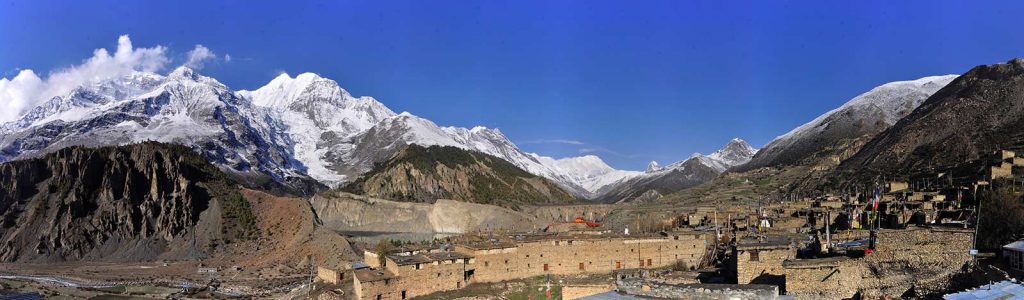
Manang sits at 11,545 ft (3,519 m) with panoramic views all around. Although we were frustrated about skipping Tilicho Lake, we were glad to be safe from avalanche and snowy hazards. The trail steadily climbed without incident, and visibility grew as the day went on.
Mountain Peaks of the Annapurna Region
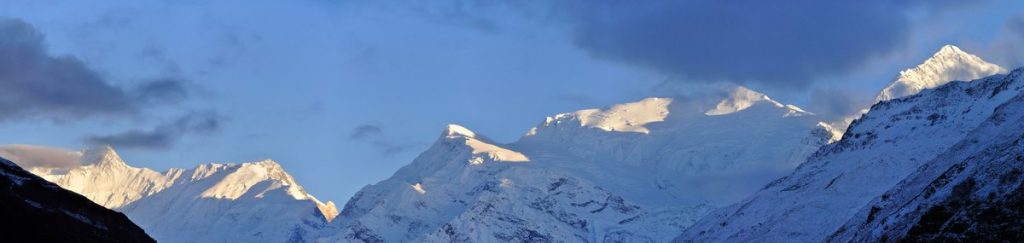
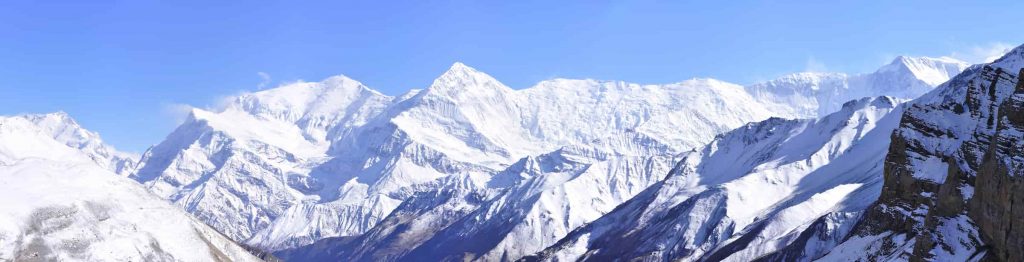
Mountain peaks began popping out of the clouds. I couldn’t keep Annapurna I, II, and III straight from one another, let alone from Gangapurna and the others Thakur pointed out. He patiently answered each time, and I spent evenings bringing him photos on my laptop to identify later — made easy by our porter carrying the extra gear. Most peaks were completely snowcapped with occasional rock faces shining through.
Flurries came down here and there, but the trail was otherwise well packed. Before long, Thakur started telling me that many peaks I pointed out didn’t actually have names — sometimes they were faux peaks, other times just nameless mountains among the majestic Himalayas. A no-name mountain was a foreign concept to me, but I guess when you’re living among giants, not everything gets a name, like the snowy one in the photo below.
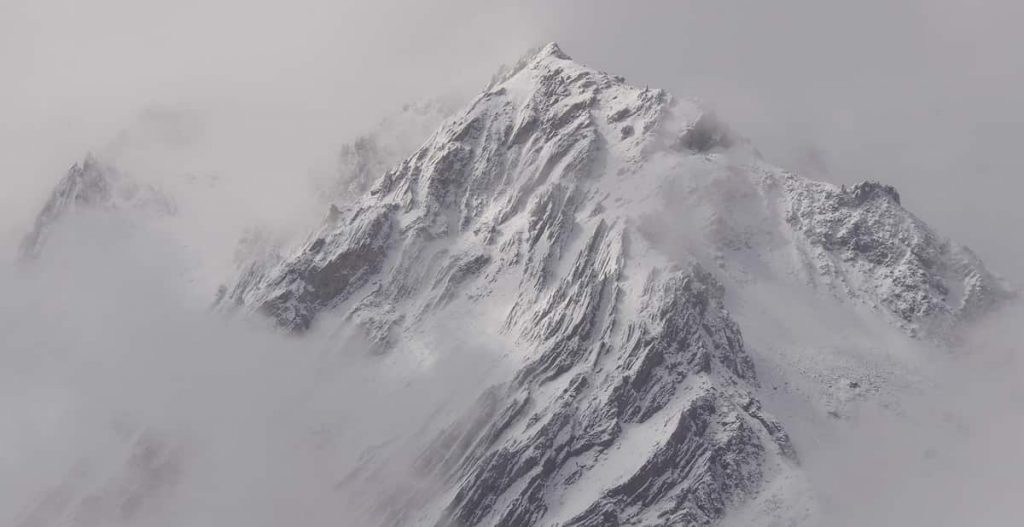
What to Expect: Manang to Yak Kharka Distance and Elevation
Since we skipped Tilicho Lake, there was no rush. Tonight we’d sleep in Yak Kharka, tomorrow night at Thorong Phedi. We had all day to walk less than 7 miles (11 km) and gain about 2,000 feet (800 m) of elevation — a hike that would normally take just a few hours. Our leisurely pace allowed for plenty of photo breaks, and I wasn’t complaining.
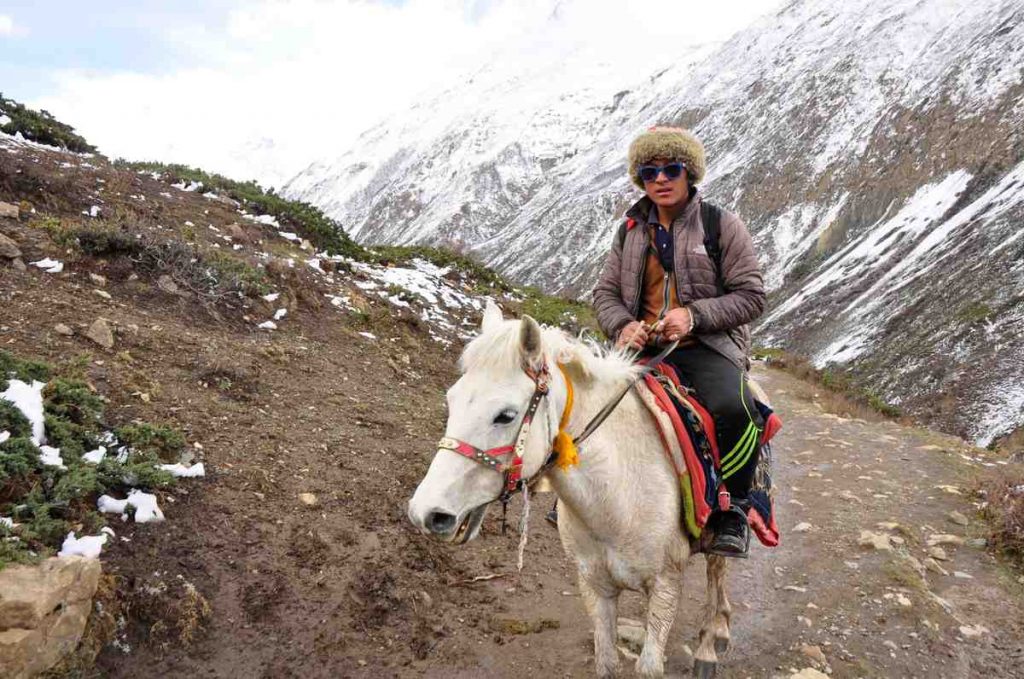
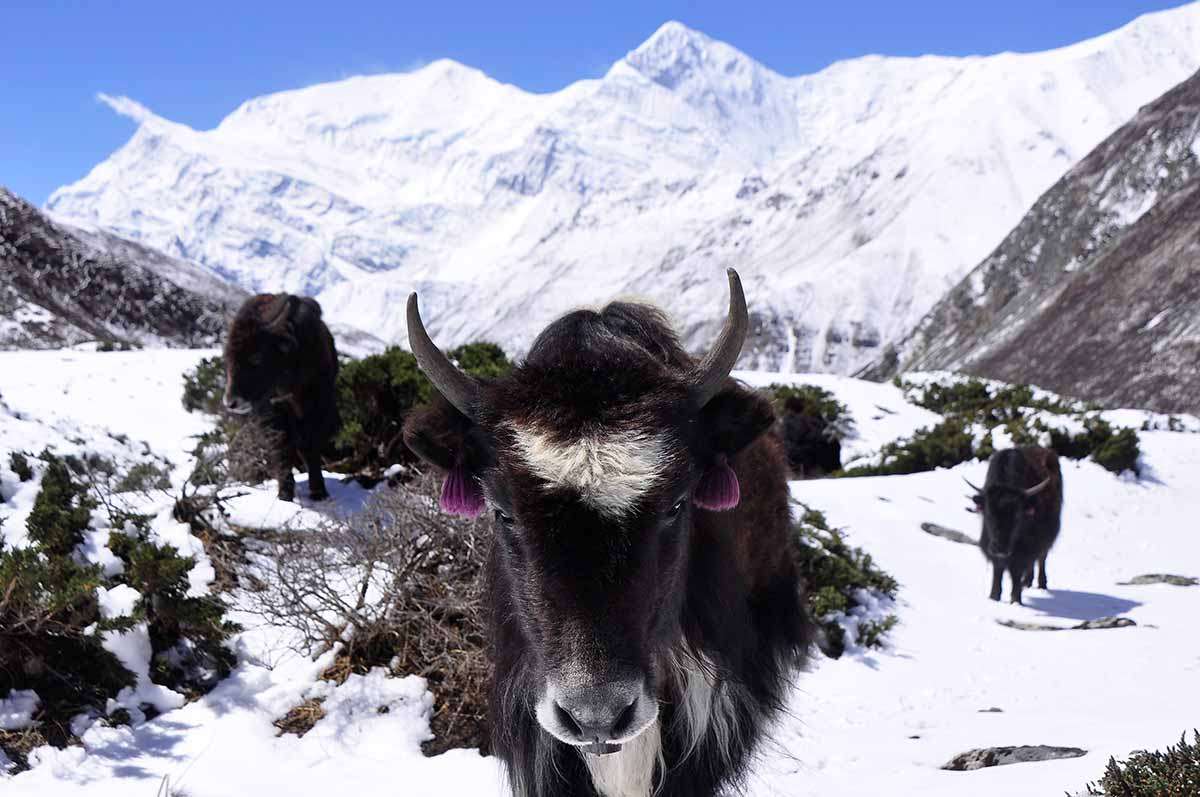
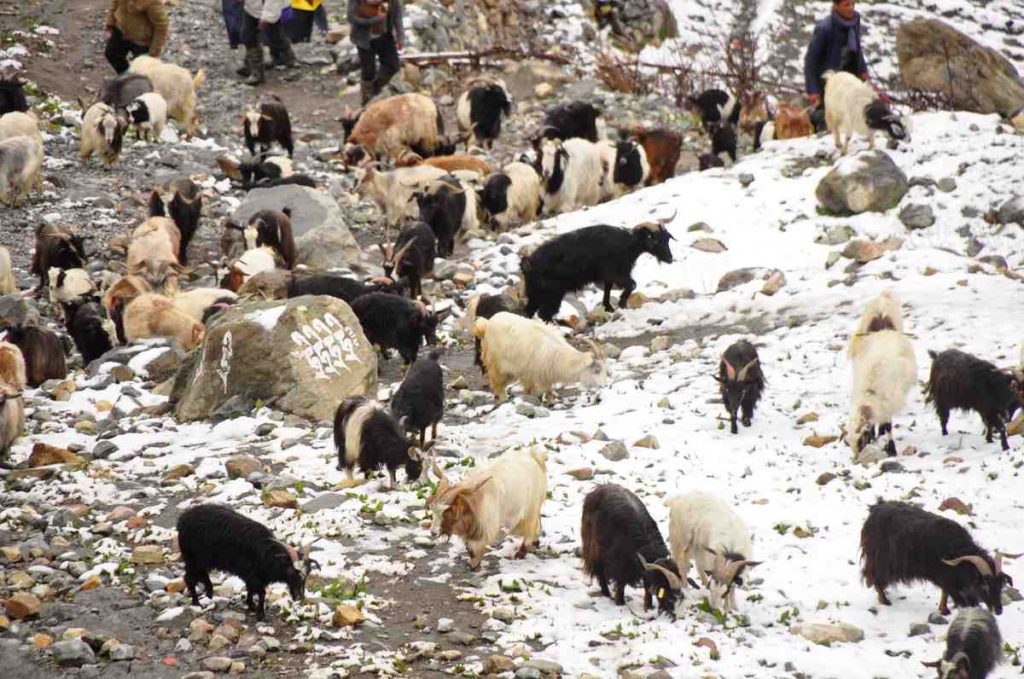
We saw few people on the trail, mostly hikers we leapfrogged back and forth along the way. We passed a local dressed in traditional garb, a goat herder, and eventually a herd of domesticated yak.
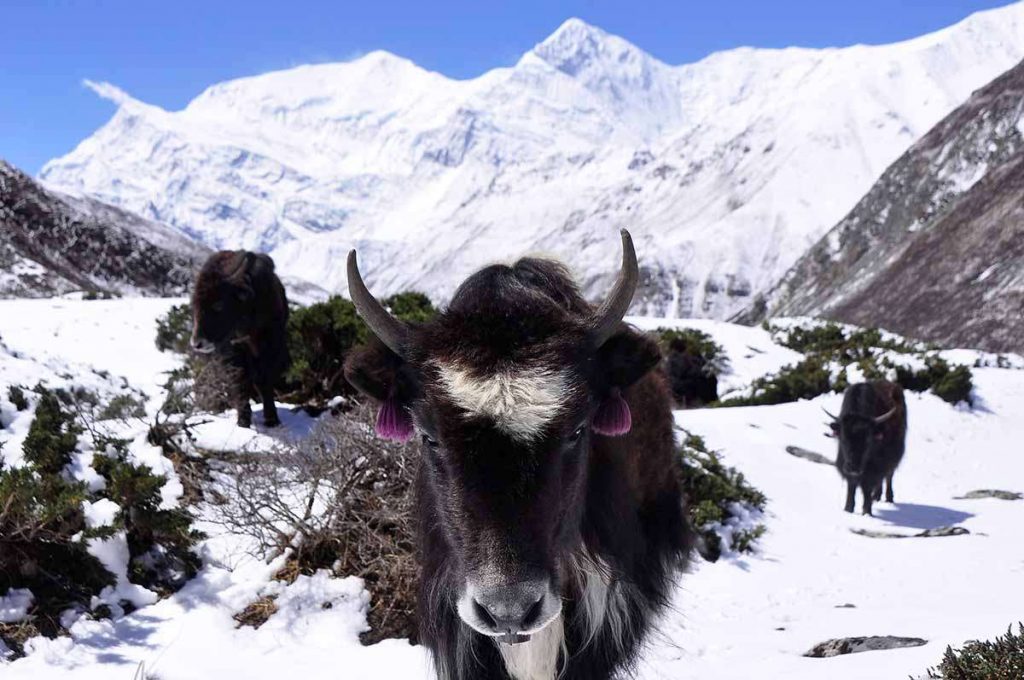
Encountering Himalayan Yaks on the Trail
One yak stared me down as two of his friends chomped the shrubbery. I noticed deeply contrasting markings on their fur and two very sharp horns. Thakur said they were friendly like cows — I’d just hugged a cow on the beach in India and decided this guy wasn’t huggable. But I crept closer for a photo. Purple earrings and a bell on a necklace signaled domestication. The yak stood gently ruminating, its eyes following me, curious about the clicking of my camera. I composed a photo with the Annapurna peaks and these beautiful bovines.
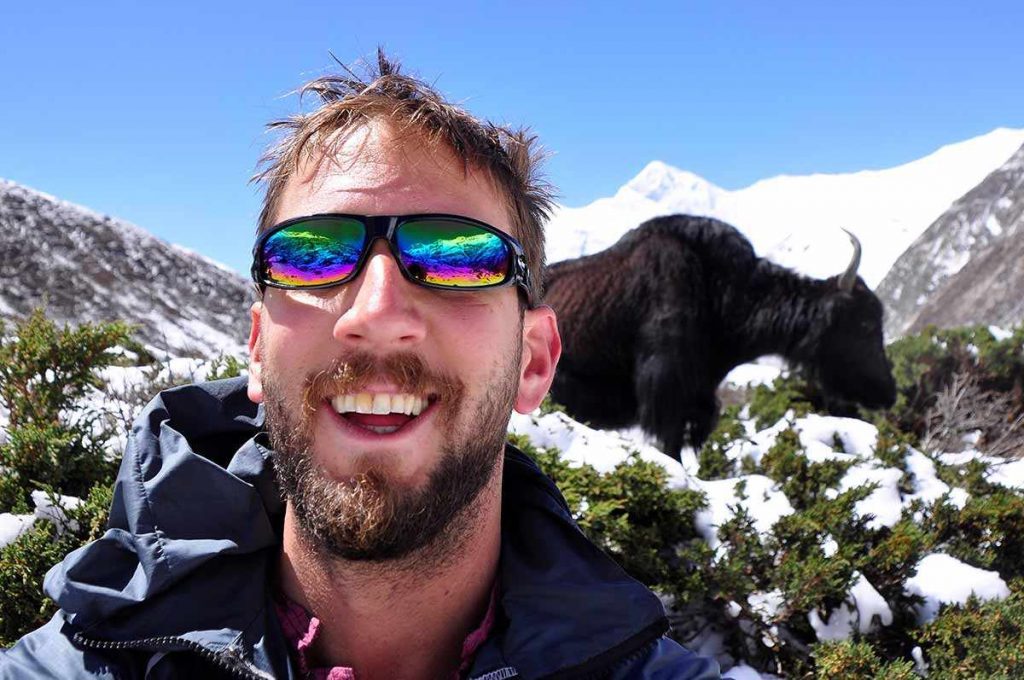
Now that I see moose regularly I feel like a crazy tourist for taking a selfie with the yak. But these yak had straight-up good vibes.
Photography Gear for the Annapurna Circuit Trek
Annapurna I and II stand at over 26,000 feet (8,000 m) while the other notable massifs in the region are just slightly shorter. They’re incredible to see, and a good zoom works wonders. I travel with my Tamron 18-270mm — it’s been my workhorse lens for over a decade with the perfect zoom range for mountain photography and a smaller footprint than a traditional 18-300mm. At $399 on Amazon it’s a steal and when I published this post you could find them for $160 — just be sure to get the Nikon or Canon mount to match your camera!
Astrophotography at Yak Kharka
Yak Kharka was barely a blip on the radar — a tiny village on the trail. We spent time relaxing, processing photos, and reviewing the plan for crossing Thorong La. By dinnertime the clouds parted, promising a beautiful day tomorrow and excellent stargazing tonight. With another short, easy day ahead and our porter handling the heavy lifting, I convinced Ben to head out to Yak Kharka’s dark skies for some astrophotography — a chance to capture the Milky Way Galaxy and try my luck at star trails.
Thinking back through my hundreds of star photos I’ve now taken while aurora chasing for almost a decade, this night in Nepal yielded my very first successful astrophoto. I pointed the camera back toward Annapurna and clicked. The frame looked good — it even let me autofocus on the distant peak. Ben had a remote, and I did some quick math. If I really wanted star trails, I’d need minutes of exposure, so we set the camera past the standard 30 seconds to bulb, compensating with ISO and aperture. I snapped another photo, this time 16 minutes long.
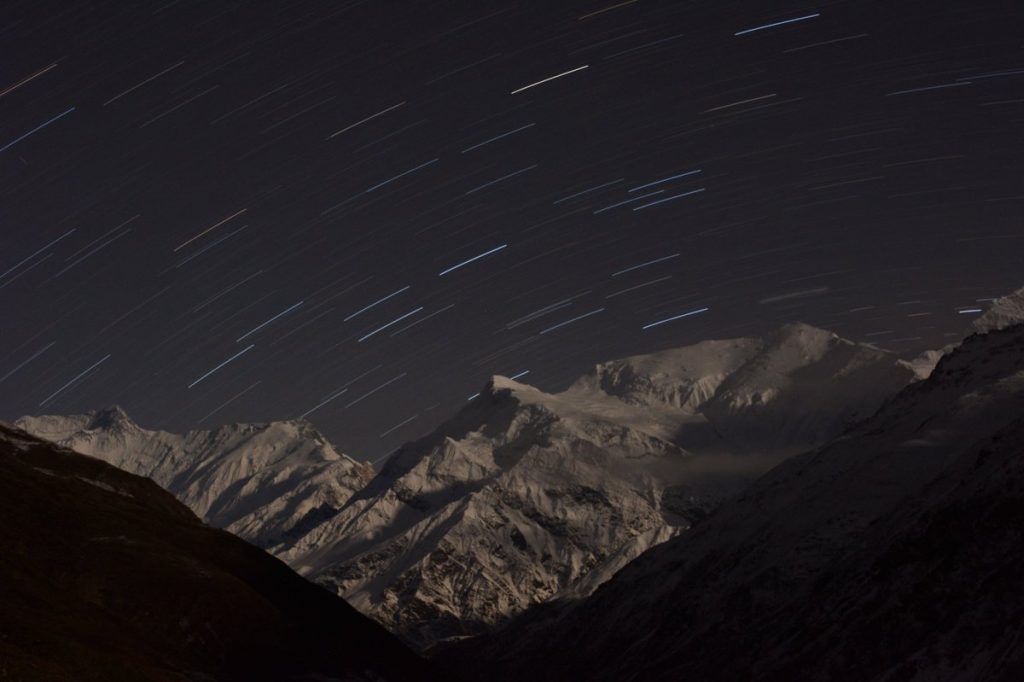
Have you ever counted the seconds for something? How about the minutes? I spent the first few staring at the sky looking for shooting stars, but it was cold and we were exhausted. Thankfully, this came out on the very first frame! It’s still one of my favorite photos and hangs beautifully in my home.
Day 7: Yak Kharka to Thorong Phedi Trek
We awoke to blue skies and quickly got back on the trail. Today was just 1,300 feet (400 m) of elevation gain on a 4 mile (6.4 km) path curving safely through the mountains, often hiding the named peaks.
Donkey trains passed us carrying what I assumed included our dinner headed for Thorong Phedi. Perhaps they were making the journey all the way over the pass to Muktinath. Thakur told us it’s nice to see the pack animals because they’re the best way to descend if you have altitude sickness — much cheaper than a helicopter if you get injured!
Photographing Annapurna and Chulo West
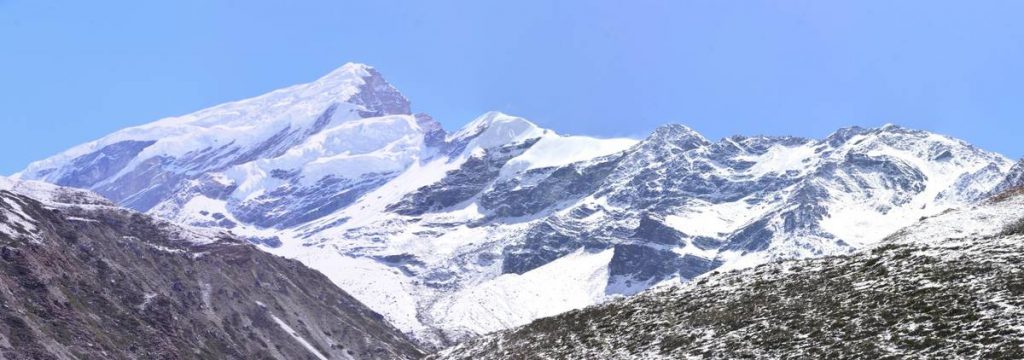
The Annapurna peaks appeared again. I snapped a photo but wasn’t satisfied. We kept walking and I’d see another angle. I needed a great shot of Annapurna — it was the namesake of this trek, after all. Then another massif slowly came into view to our west. It didn’t look particularly high and wasn’t even snowcapped, but the contrasting rock faces and snow paths drew my photographer’s eye. Thakur surprised me with the name Chulo West before I even asked. I stopped and took another dozen photos to stitch into a panorama.
Encountering Blue Sheep (Bharal) in a Landslide Zone
We were nearing Thorong Phedi when Thakur called us to a halt. A group of locals warned him that the next stretch of trail was covered with landslide debris. Landslides are always a hazard, but fresh debris is a warning sign. He quickly explained the plan: when we got to the landslide, we just needed to keep moving until we got around the bend. There was a chute above us that could easily send more debris down.
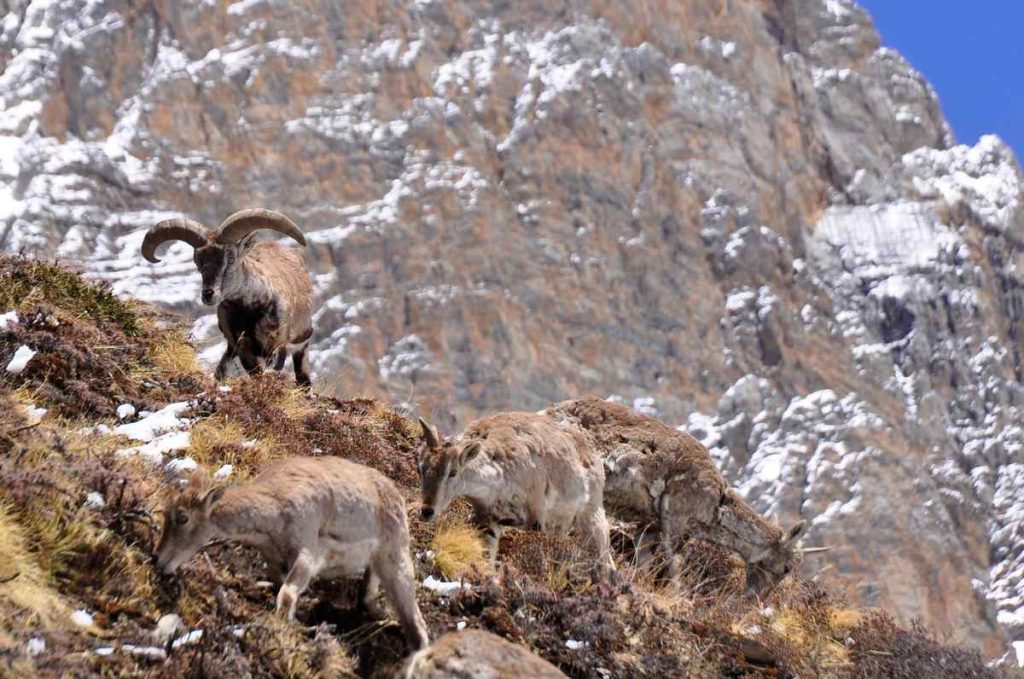
We walked quickly into the landslide debris — Thakur was right — it felt no different from walking on the trail. Then small rocks started coming down further ahead. I heard someone shout. Then larger ones. Wait — are those legs? That is clearly an animal. And another!
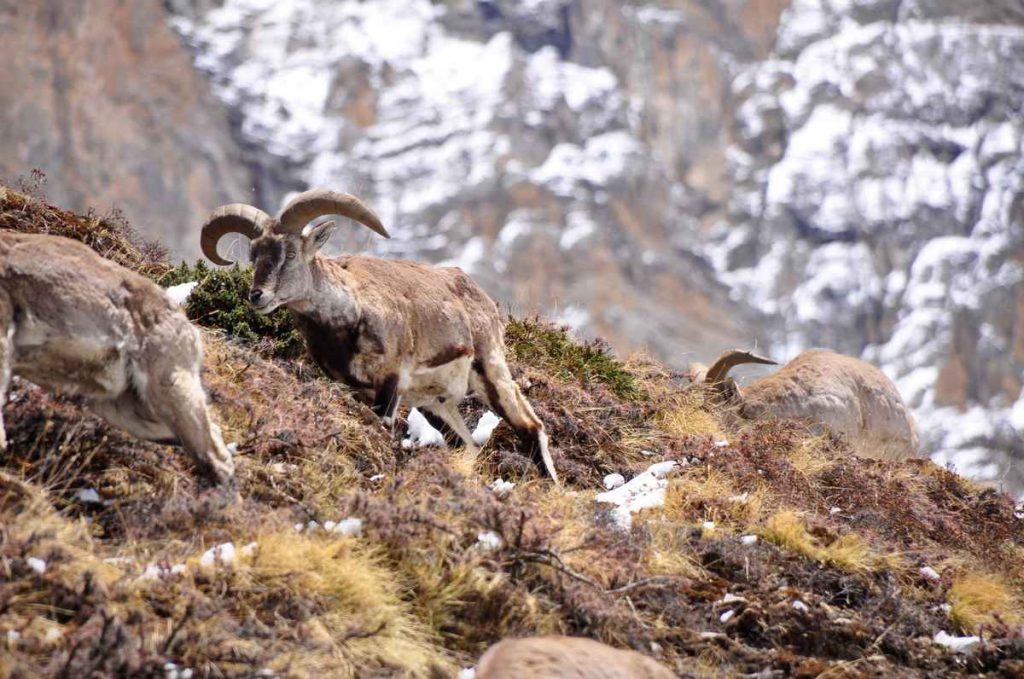
Before we knew it, a herd of bharal — which Thakur called “blue sheep” — appeared! I wanted to stay and take photos. I could have taken hundreds as the herd came into view, but we were stuck in the middle of a landslide zone. My eyes were less focused on the trail, but my brain kept my feet in check. Okay, maybe I still took a hundred photos of the bharal. They moved on quickly enough that I didn’t feel bad for having to scurry out of the rubble.
What to Expect at Thorong Phedi Base Camp
We made it to Thorong Phedi before long. There’s a gorgeous mountain lodge sitting at roughly 14,600 ft (4,500 m). Aside from the mountains and this structure, Thorong Phedi is unremarkable — but when you consider the effort it took to build a massive mountain lodge nearly three miles above sea level, it’s quite impressive.
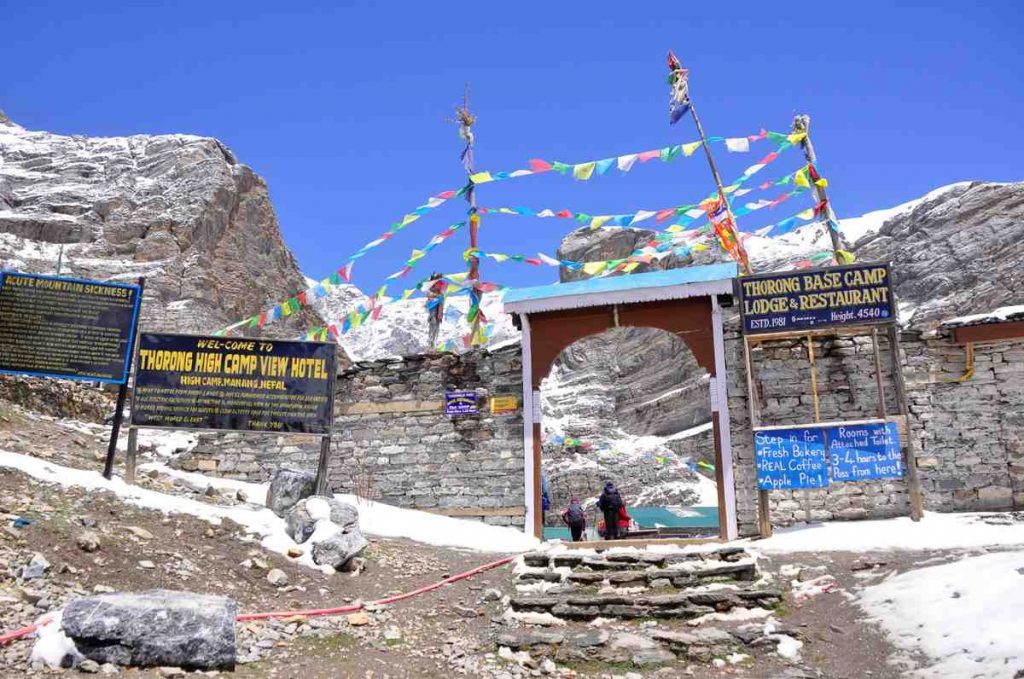
We made a plan to get up well before the crack of dawn and were planning an early bedtime. Time to tuck in and get ready for the toughest day on the Annapurna Circuit — up and over Thorong La!
Day 8: Thorong La Pass — The Hardest Day
We woke early to starry skies. Just over 9 miles (15 km) of trail with nearly 3,000 feet (900 m) of climbing before over 5,000 feet (1,600 m) of descent. Today was going to be a knee killer for sure, but clear skies and an early start promised a good day ahead.
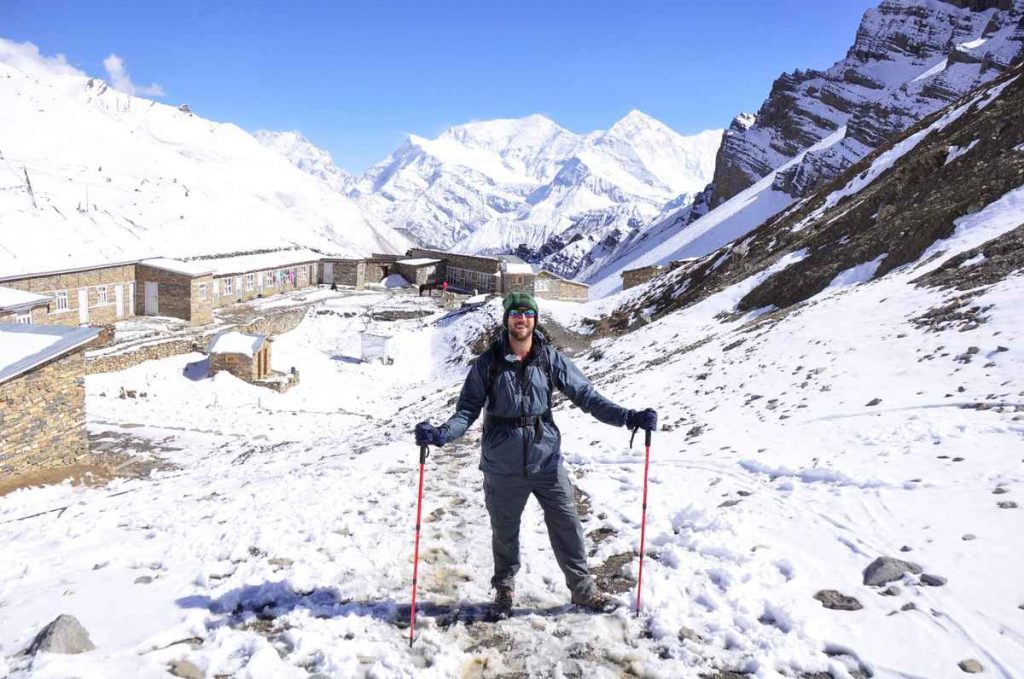
The minimal snow on trail beforehand didn’t prepare me for the hike up Thorong La. We started with a steep series of switchbacks — slick but not totally snow-covered. We made good progress before the sun came up, and we paused a moment to appreciate the mountain vistas in front of us.
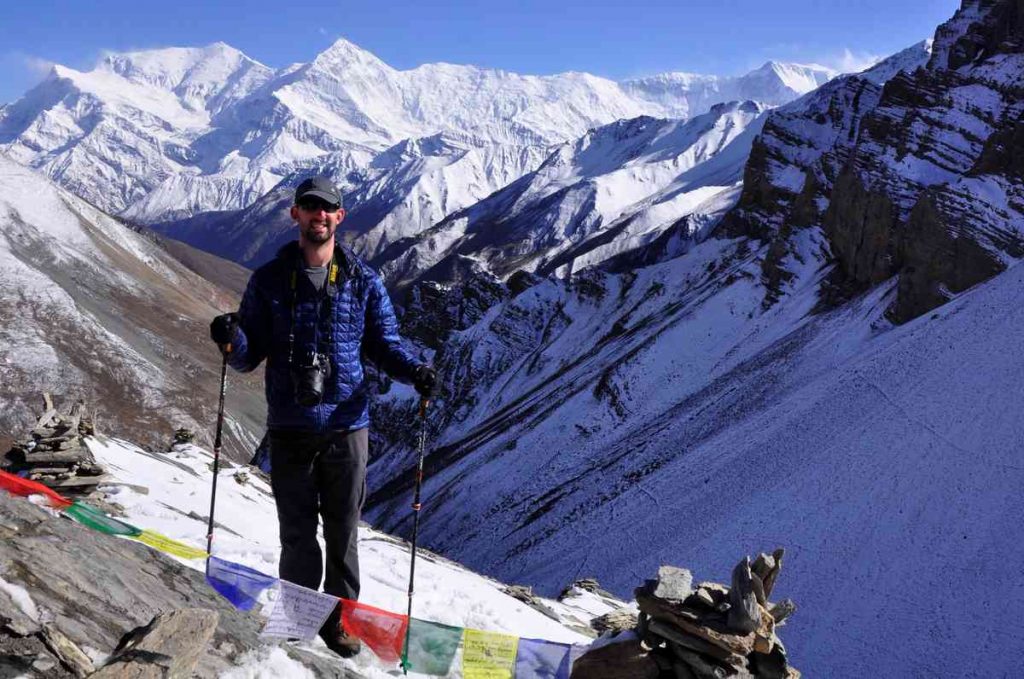
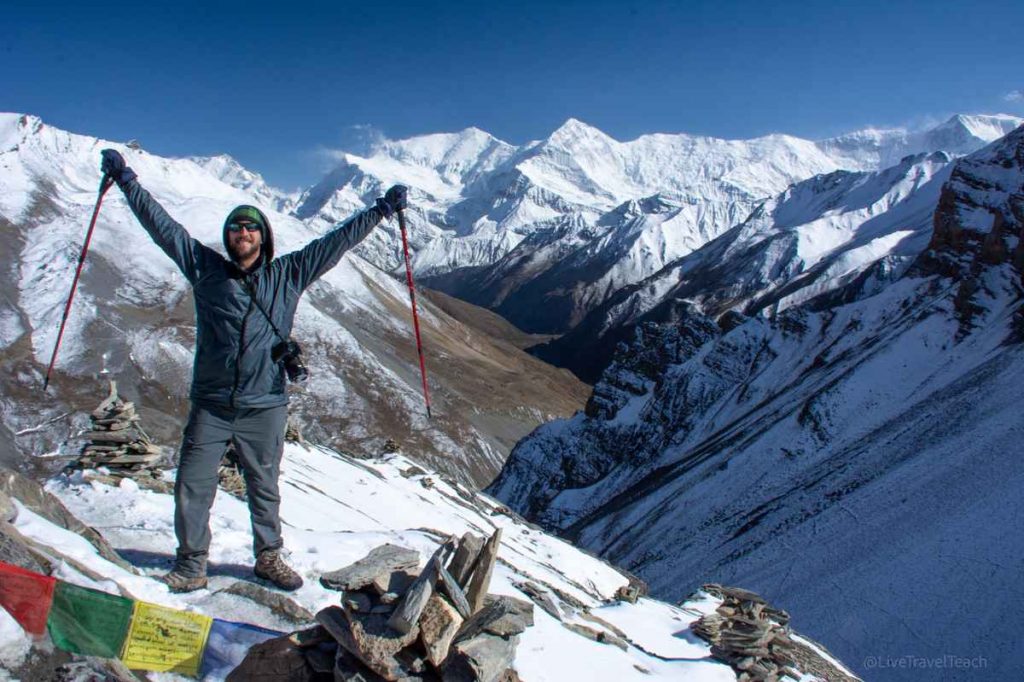
Annapurna was finally posing for a gorgeous shot with prayer flags framing the scene — we posed for a few photos before continuing. The expanse ahead was now shallower than our start but more snow-covered.
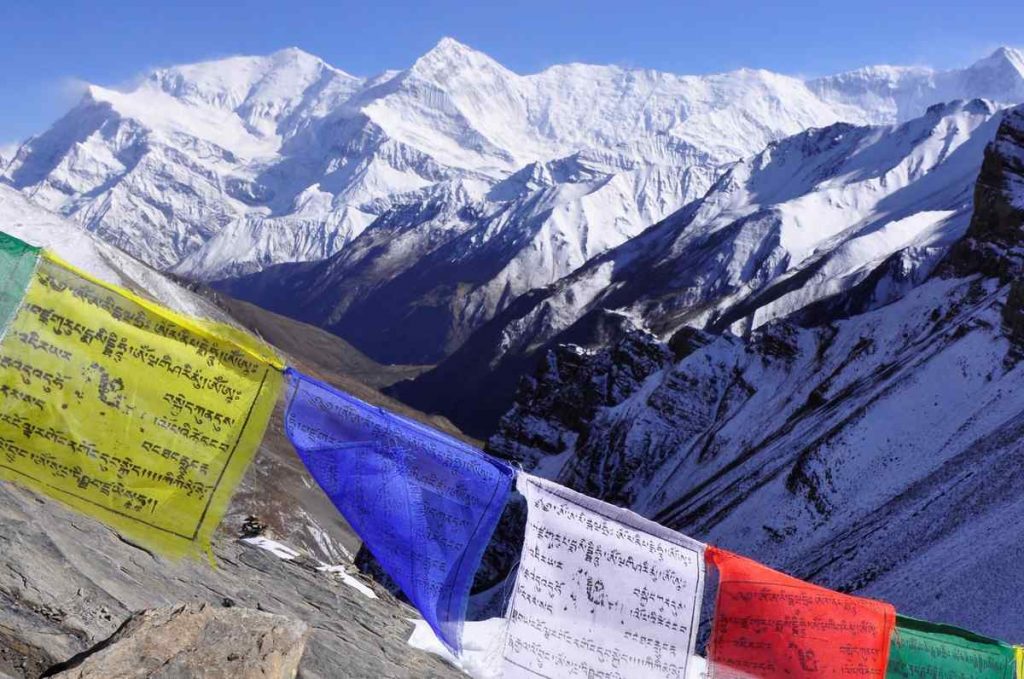
Ben donned his microspikes and I realized I would have loved a pair too but hadn’t thought of it. I had only done a few winter hikes beforehand and didn’t realize how uncomfortable I’d be trekking on snow. The trail was well-maintained and most people hiked with just their boots, which I tried to take comfort in.
Before long we rounded a bend to a slight commotion ahead. Any semblance of snow-free trail was now gone. A small group was putting on microspikes, with one especially nervous hiker debating turning around. Apparently they had slipped — not fallen any distance — but quickly realized they were above a steep descent. I thought about my own discomfort and lack of spikes. I had two poles. That would be enough, right?
The Mental Challenge of High Altitude Trekking
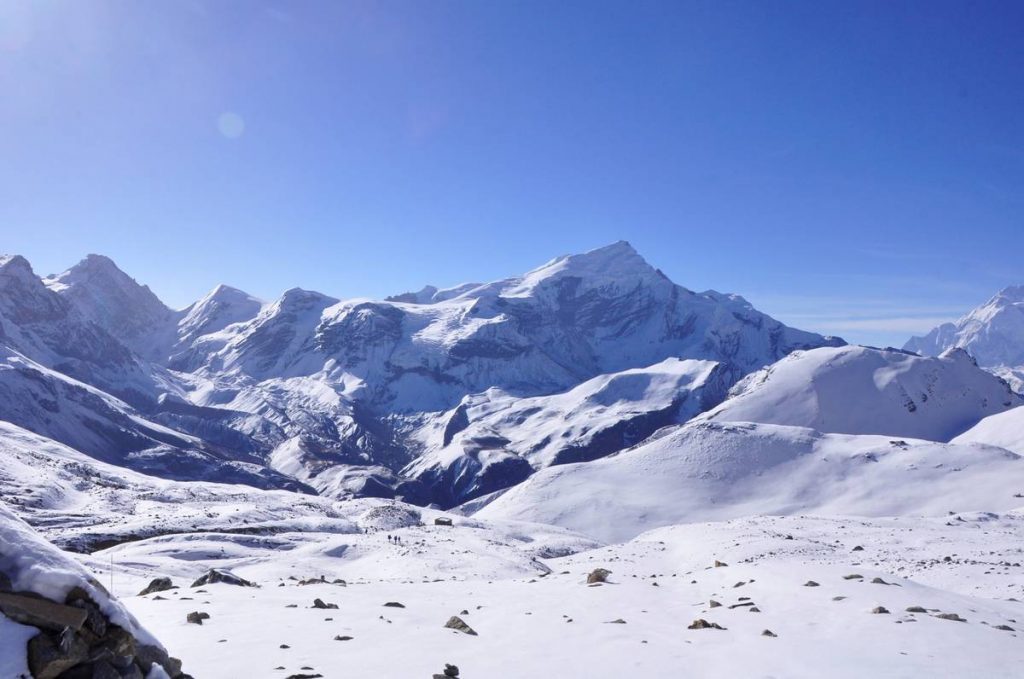
Although I didn’t worry about falling, I felt my feet slide backward with each step. Maybe it was all in my head, so I looked down to check. That was a mistake! The hill we were on sloped steeply downward, perfect for sledding — until you realized it ended in a cliff. I couldn’t see the bottom — maybe it wasn’t that far down, but a vast void opened between us and the peak in the distance. If you slipped here and didn’t catch yourself, you’d be in trouble.
I froze. This has only happened to me once before, at the top of Angel’s Landing. Mentally I knew I was safe and secure. I knew my feet were stable. I trusted my steps. But I couldn’t make them move. Turning around wasn’t an option. Was it?
No way. I didn’t want to turn around. But how could I move forward like this? I didn’t trust my steps — had I just lied to myself saying I did? Ben noticed my anxiety and made the quick decision to give me one of his microspikes. We’d each have one on the outer foot. That plus our poles and we’d be fine. In hindsight the microspike was purely a mental relief. I’ve now hiked countless miles on snow and know my footing, but without experience to tell you what’s possible, your mind can make up some pretty gnarly scenarios.
We passed this treacherous section without further incident, but my nerves were still shot. I barely took my camera out the rest of the way up to Thorong La. I took the scenery in but mostly stared at my feet. I was still getting used to hiking on snow, and even though the trail no longer hinted at such dire consequences, I decided not to complicate things with as many photo stops as usual.
Reaching Thorong La Pass at 17,769 Feet
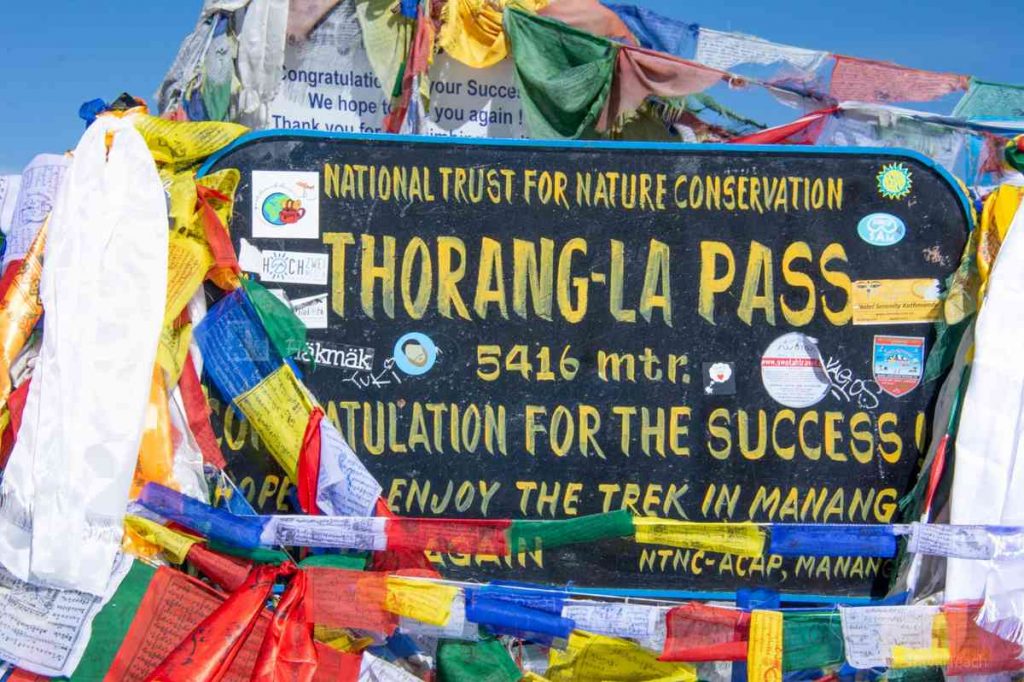
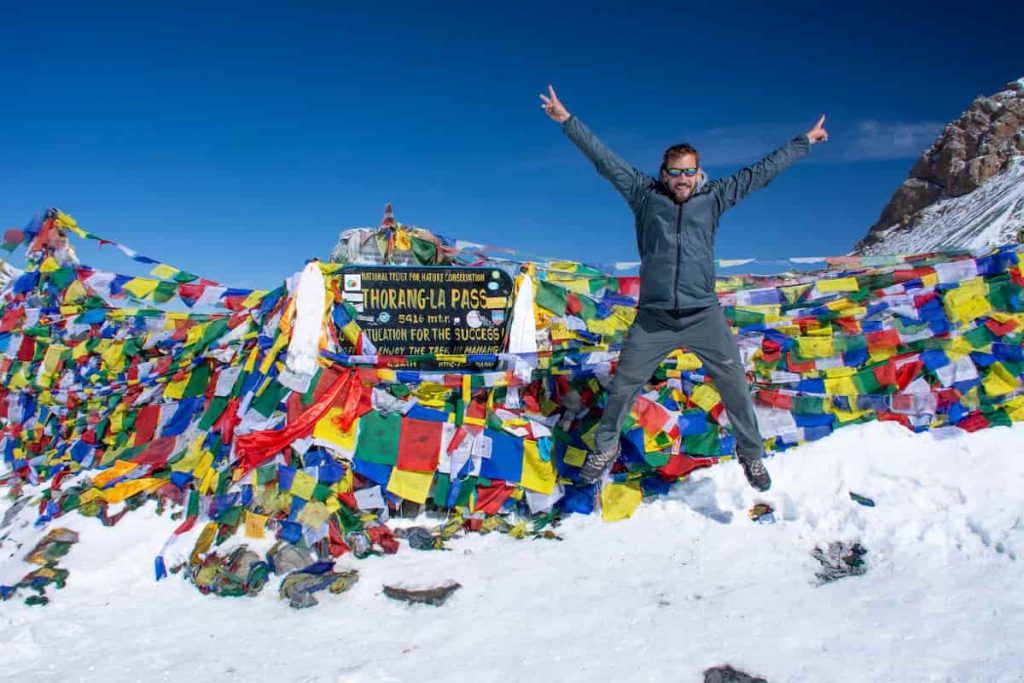
The vistas were stunning. We couldn’t have asked for better weather. The air was thin, but we were ready for it. Approaching our summit at 17,769 feet (5,416 m), we found a guestbook to sign, countless prayer flags, and a few signs congratulating hikers for the achievement, declaring our location and elevation. The stone shelter had somehow become a convenience store hawking hot tea and trail snacks. I didn’t ask questions, I just ordered.
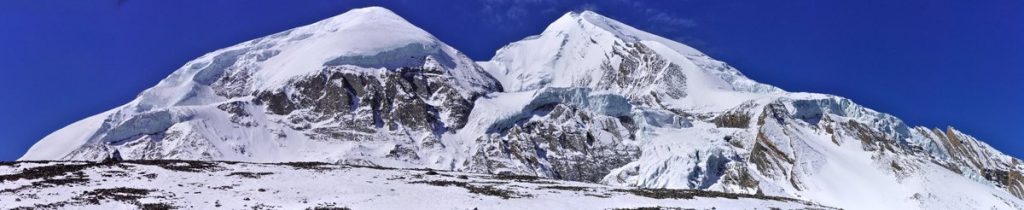
After we posed for our group shots, I finally had the chance to look around and truly enjoy the view without worry. The moment of weakness was now hours past and already a distant memory. I took my camera back out and captured everything. My eyes were drawn to the glaciers dangling off the peak of Thorong La. People climb that? I thought about how insane that must be. I felt out of my comfort zone enough just on the hike to the pass — no way I’ll ever summit that kind of mountain.
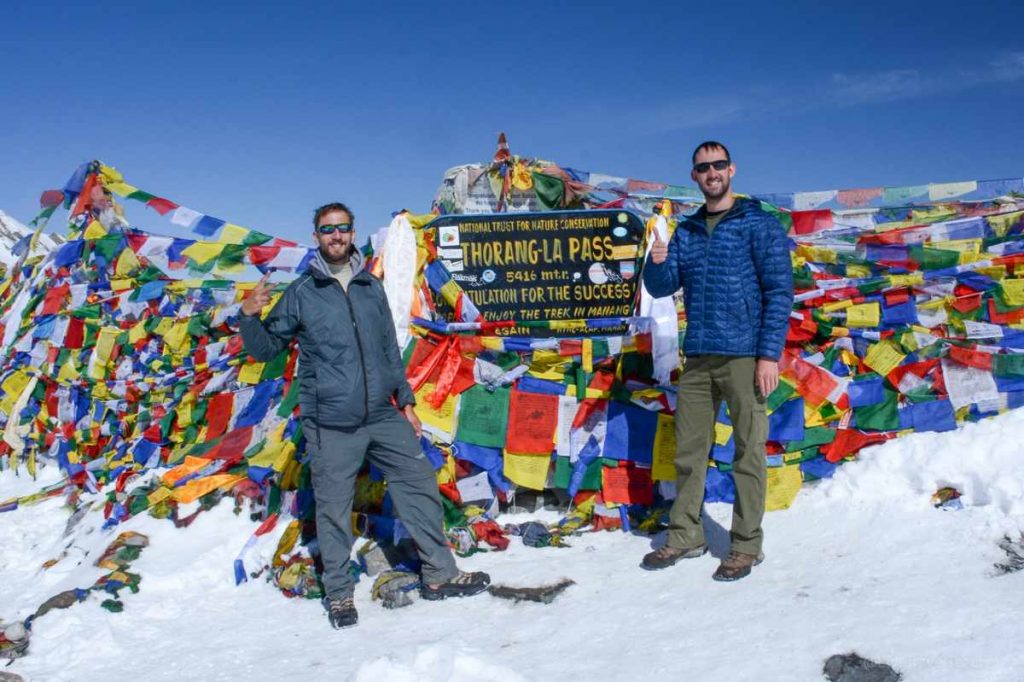
Thakur urged us onward even though I wanted more photos and a snack. He said this was a trap that many hikers fell into. Between the altitude and the exertion, we needed to keep moving and start descending or we could find ourselves in real trouble. Plus there were still many miles before we got to our hotel for the night. His wisdom convinced us to keep moving.
Descending to Muktinath
The hike down was both easier and incredibly more difficult. 5,000 feet (1,600 m) of descent made a beautiful view but signalled hell for our knees. There were no anxiety-inducing moments — the snow seemed to stop abruptly after we started the descent. The trail was well-maintained with more switchbacks than my brain wants to remember. Before long we could see Muktinath below us. Far below us.
A snack break came and went, our knees wishing for a longer break — or better yet, one of those pack mules to take me down the rest of the way. We shared jokes and stories to pass the miles before finally reaching our destination, completely drained but feeling accomplished. This was the hardest hike I’d ever done. I conquered a fear I didn’t know I had, and I felt grateful to my brother for helping me through it all.
Our hotel in Muktinath was only memorable for its bed. It was the most glorious bed I’ve ever slept in. Now that I think about it, they also had all-you-can-eat dal bhat with flavors exploding far beyond the $2 price tag. A chance to relax after a long hike makes even the worst accommodations feel like five-star luxury.


